The Tinsley family migrated to Ireland from England during the seventeenth century. In the fall of 1851, William Tinsley, a builder who had inherited a strong tradition of house building, and his family left Clonmel in County Tipperary in southeastern Ireland for New York fleeing Catholic uprisings. Several days after their arrival the Tinsleys journeyed to Cincinnati where he opened an architect's office. Tinsley supervised the construction of several college buildings in Indiana and Wisconsin, erected the Tyler-Davidson fountain in Cincinnati, and built the Owen County jail and the Boone County Courthouse in Indiana. Upon his return from the University of Wisconsin, Tinsley agreed to design an academic building at Kenyon College.
Tinsley said, "my good and never changing friend Bishop McIlvaine introduced me" to Kenyon. The Parishioners from the Church of Ascension in New York City funded the construction. The architect's plans for North Western Christian University and Indiana University served as the models for Ascension Hall. In the April 28, 1857 the Board of Trustees of Kenyon College drew up and adopted the plans for Ascension Hall. Bishop Charles Pettit McIlvaine laid the cornerstone of Ascension Hall on June 30, 1860. All stones used in the building of the various structures designed by William Tinsley came from the quarry owned and operated by William Fish, Ascension's contractor. He opened up a quarry of olive shell and sand stone on his land about two miles northeast of Gambier for the building of Ascension Hall. The abandoned quarry is now owned by Tom and Shirley Lepley. It lies about a quarter of a mile north of the chapel on the western side of Monroe Mills Road.
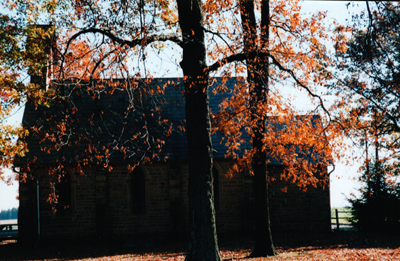
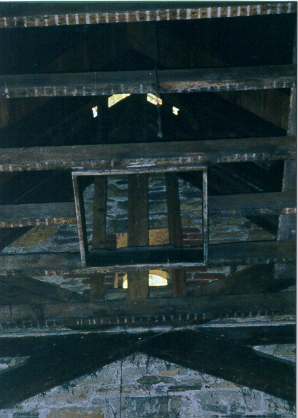
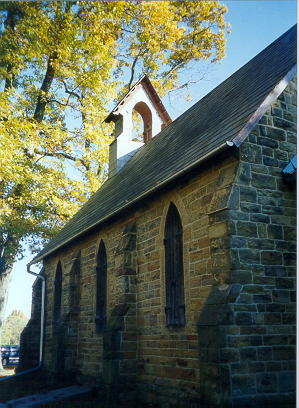
Tinsley also did other work in the village of Gambier supposedly building the gabled cottage, Kokosing, for Gregory Thurston Bedell and the Christ Church at the Quarry, across the way from Fish's quarry. The Chapel resembled a Tinsley-designed building. In Victorian Architect, J.D. Forbes stated that there are grounds for suggesting that Tinsley designed the chapel. It resembles the church at Clogheen in County Tipperary which Tinsley built from plans furnished by James Pain. Forbes described both edifices: "Both the little open-arched belfry straddling the gabled end of the roof and the peculiar profile and location of the buttresses flanking that gabled end are alike in the two buildings. The buttresses are deep at the base and for four or five feet above the foundation line, then slope inward to reduce their depth by half and continue almost up to the waves at diminished depth." The chapel has its roots in Irish architecture linking the stone masons back to their European heritage. |