| The Building of Quarry Chapel
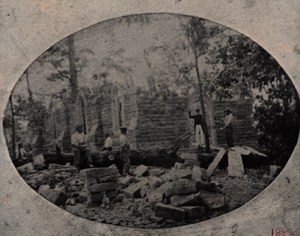
It is difficult to discern what actually took place during the building of Christ Church at the Quarry, as few physical documents concerning the church remain. There exists a photograph of the Chapel being built, but, unfortunately, it is not accompanied by names or occupations. The names of the people in the pictures may, unfortunately, may be lost. Much of what we know today is historical heresay. The accounts used adhere to the same set of facts, so it is likely that there is merit in these accounts. In the 1850s, a religious revival took place among the students of Kenyon College. This, coupled with an increasing population in Gambier, created a need for a church (Church of the Holy Spirit had not yet been built. It was not finished until 1869). Originally, people wanted to build a frame building to house services and a Sunday School. This idea was rejected by William Fish, who thought that a stone church would be much better than a wooden frame church. Since he owned the local quarry, Fish also willingly donated the stone for the building of the church. Bishop Bedell, then the bishop of the Diocese of Ohio, agreed to the plans. Accounts differ as to whether it was Mr. Fish or William Tinsley, a Diocesan architect from Ireland, who developed the plans for the church. Mr. Tinsley, who is also the architect for Ascension Hall on Kenyon’s campus, was most likely the architect for the chapel. As Louise Adams, who wrote a piece about the founding of the church, relates, "The chapel as it stands looks suspiciously like a Tinsley structure, strongly resembling the church at Clogheen in Ireland." She goes on to mention that, "Tinsley was working in Knox County at the time the chapel project began and as Mr. Fish was involved in both buildings [Ascension and the Kokosing house, Bishop Bedell’s residence] it was reasonable that Tinsley would be interested and perhaps donated his plans." The chapel was constructed on land generously by John G. Bateman, and the stands on the original route that Bishop Chase used in getting to. The finished chapel stands at the corner of Quarry Chapel Road and Monroe Mills Road in Gambier, Ohio. The building of the chapel was a community project. Stone masons may have been imported from either England or Ireland (the native countries of Fish, Bishop Chase, and Tinsley) for the construction of several buildings on Kenyon’s campus. As Bessie Rowley Bateman, a former parishoner of the church, put it, "trees were felled in the neighboring woods-- stone was quarried and chiseled, and the lasting results of their labors is the small but neat and appropriate stone chapel that graces the quarry knoll." Bateman attributes the building of the chapel simply to the local settlers. The building of the chapel progressed steadily until the exterior was finished in the winter of 1863, and the building was consecrated on January 18, 1863 by Bishop Bedell. In the words of Bishop Bedell, the first service was as follows:
The life of the Quarry Chapel began inauspiciously. In the following months, furnishings were provided by the community. A local resident named Peter Parker is credited with carving and donating the stone font which stood in the chapel. The "Ladies of Gambier" (who remain largely shrouded in mystery) tirelessly raised money to furnish the fledgling chapel. If ever a community rallied around a common cause, the Quarry Chapel was such an effort. After it was built and furnished, the chapel was actively used for over forty years. It eventually fell into disuse and, even though it remains a symbol of the Gambier community today, the chapel that was the product of the effort of an entire town was left to simply collapse on its own. |