The Interpenetration of Stillness and Activity
in Chu Hsi's Appropriation of Chou Tun-i
Association for Asian Studies
Annual Meeting
Boston, 1999
Joseph A. Adler
Kenyon College
March 15, 1999
(This paper has been partially incorporated into
"Zhu Xi's Spiritual
Practice as the Basis of his Central Philosophical Concepts")
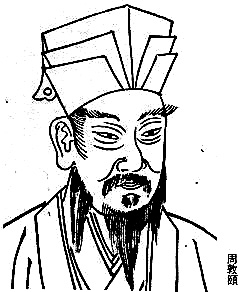
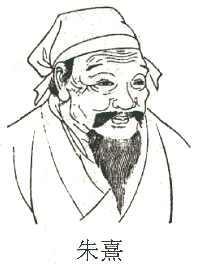 Why did Chu Hsi (1130-1200, right) elevate Chou Tun-i (1017-1073, left)
to the position of the first true Confucian sage since Mencius (4th
c. BCE)? This question, which has never satisfactorily been answered,
is closely related to the question of Chu Hsi's assessment and use of
concepts that were generally recognized in the Sung dynasty to be of Taoist
provenance. The connection of these two problems was the issue debated
by Chu and the Lu brothers (Lu Chiu-shao, 1120s-1190s, and Lu Chiu-yüan,
1139-1193) in a well-known exchange of letters in 1186-1187. In this famous
argument, Chu Hsi defended Chou Tun-i against the charge of being too
Taoist to be posthumously admitted into the Tao-hsüeh fellowship
- much less to be considered the first true sage of the Sung. Most scholars
agree that in this dialogue Chu Hsi failed to refute Lu Chiu-yüan's
claims that Chou Tun-i's "T'ai-chi Diagram" (T'ai-chi-t'u)
had originated in Taoist circles, and that Chou's term wu-chi,
in his "Explanation of the T'ai-chi Diagram" (T'ai-chi-t'u
shuo), was a Taoist term that had never been used by Confucians (with
good reason, according to Lu). Nevertheless, Chu's position eventually
prevailed, and ever since then Chou Tun-i has traditionally been listed
as the "founding ancestor" of the Tao-hsüeh movement as
constructed by Chu Hsi. Chu may have lost the battle, but he certainly
won the war.(1)
Why did Chu Hsi (1130-1200, right) elevate Chou Tun-i (1017-1073, left)
to the position of the first true Confucian sage since Mencius (4th
c. BCE)? This question, which has never satisfactorily been answered,
is closely related to the question of Chu Hsi's assessment and use of
concepts that were generally recognized in the Sung dynasty to be of Taoist
provenance. The connection of these two problems was the issue debated
by Chu and the Lu brothers (Lu Chiu-shao, 1120s-1190s, and Lu Chiu-yüan,
1139-1193) in a well-known exchange of letters in 1186-1187. In this famous
argument, Chu Hsi defended Chou Tun-i against the charge of being too
Taoist to be posthumously admitted into the Tao-hsüeh fellowship
- much less to be considered the first true sage of the Sung. Most scholars
agree that in this dialogue Chu Hsi failed to refute Lu Chiu-yüan's
claims that Chou Tun-i's "T'ai-chi Diagram" (T'ai-chi-t'u)
had originated in Taoist circles, and that Chou's term wu-chi,
in his "Explanation of the T'ai-chi Diagram" (T'ai-chi-t'u
shuo), was a Taoist term that had never been used by Confucians (with
good reason, according to Lu). Nevertheless, Chu's position eventually
prevailed, and ever since then Chou Tun-i has traditionally been listed
as the "founding ancestor" of the Tao-hsüeh movement as
constructed by Chu Hsi. Chu may have lost the battle, but he certainly
won the war.(1)
-
The two aspects of the problem, then, are (1) why was Chu Hsi willing
to transparently try to explain away Chou Tun-i's evident debts to Taoism,
and (2) why was he so intent on declaring Chou to be the first Confucian
sage since Mencius? I will argue that a fuller understanding Chou Tun-i's
use of Taoist and possibly Buddhist categories is the key to his significance
for Chu Hsi. I will further argue that this understanding of Chu Hsi's
appropriation of Chou Tun-i leads to a useful reinterpretation of some
of Chu Hsi's central concepts. More specifically, I will propose that
the key to Chu Hsi's evaluation of Chou Tun-i - and to his interpretation
of t'ai-chi, which in this context should be translated as
"Supreme Polarity" - can be found in Chou Tun-i's concept of the interpenetration
of activity and stillness (tung-ching) under the rubric of
the yin-yang polarity. This concept provided Chu with philosophical
grounding for his solution to the major issue he grappled with during
the 1160s, the problem of the cultivation of the mind. His solution
to this problem constituted the major turning point in Chu's philosophical
career. Significantly, it was just after this breakthrough that Chu
began his commentaries on Chou Tun-i's works.
The problem(2)
Chu's claim that Chou was the independent founder of the tao-hsüeh fellowship in the Northern Sung - that he apprehended the true meaning of the Confucian Way without a teacher, and passed it on to the brothers Ch'eng Hao and Ch'eng I - was not only based on very scant evidence, it also contradicted Ch'eng I's claim that his elder brother had himself independently perceived the Tao in the Classics. Given that the Ch'eng brothers' contributions were absolutely central to Chu Hsi's philosophical synthesis, the fact that they made virtually no use of Chou Tun-i's teachings makes Chu's claim about Chou even more puzzling.(3)
It was similarly difficult for Chu Hsi to ignore Chou Tun-i's debts to Taoism, despite the fact that these were not well-documented. The prevailing view concerning the T'ai-chi Diagram, in Chu Hsi's time as now, had been formulated by Chu Chen (1072-1138), who died eight years after Chu Hsi was born. He had traced the Diagram to the famous T'ang dynasty Taoist priest, Ch'en T'uan (10th century), from whom it was passed to Ch'ung Fang (d. 1015), then to Mu Hsiu (d. 1032), and then to Chou Tun-i.(4) Ch'en T'uan had also been identified as the ultimate source of the "learning of the Classic of Change" (I-hsüeh) among the Sung Neo-Confucians by the followers of Shao Yung (1011-1077).(5) I-hsüeh was understood to include not only the T'ai-chi Diagram but also the use of the appendices of the I as a source of moral and cosmological insight. Chou Tun-i's major writings, the short "Explanation of the T'ai-chi Diagram" and the longer T'ung-shu (or I-t'ung, "Penetrating the Classic of Change"), are two of the early Sung examples of this trend toward giving the I-ching a central role among the textual sources of the Neo-Confucian revival.
The "T'ai-chi Diagram" itself is very similar to the "T'ai-chi Preceding Heaven Diagram" (T'ai-chi hsien-t'ien t'u), which is found in the Taoist Canon and has generally been considered a T'ang dynasty precursor to Chou Tun-i's diagram.(6) But some scholars have raised serious doubts about the dating of this diagram, so we cannot with any certainty place it prior to Chou Tun-i.(7) Another nearly identical Taoist diagram is the "Wu-chi Diagram," which, according to the Ming scholar Huang Tsung-yen, dated back to the shadowy former Han Taoist figure, Ho-shang Kung, and also passed through Ch'en T'uan before eventually reaching Chou Tun-i. But the problems concerning the dating and authenticity of this diagram are at least as serious as those concerning the T'ai-chi hsien-t'ien t'u.(8)
Another possible inspiration for Chou's diagram, or at least part of it, may be the diagram depicting the gradations of Buddhist enlightenment attributed to Tsung-mi (780-841). The dating of this too has been questioned, and the suggestion made that it is a later addition to Tsung Mi's work.(9) In any case, the only part of Chou's diagram that it resembles is the circle composed of alternating black and white half-rings, which evolved into the familiar yin-yang diagram seen everywhere today. But beyond the possible design influence, there are other possible Buddhist influences on Chou's thought -- and through him, on Chu Hsi's - to which I will return later.
Despite what may be the impossibility of pinning down a precursor to the T'ai-chi t'u, it is nevertheless difficult to believe that Chou Tun-i constructed it out of whole cloth. The most telling objection to such a suggestion is the fact that in his Explanation, Chou does not explain all the parts of the diagram - e.g. the two large circles at the bottom, and the small circle connecting the phases of fire, water, wood, and metal in the middle. One would expect him to fully explain a diagram that he had created. Yet we know that these elements of the diagram were interpreted by nei-tan Taoists at least in the Sung dynasty.(10) So, whether or not its pedigree extended back to Ch'en T'uan, and whether or not the nearly identical T'ai-chi hsien-t'ien t'u and Wu-chi t'u date back prior to the Sung, it seems most reasonable to assume that Chou Tun-i received the T'ai-chi t'u, either directly or indirectly, from some Taoist practitioner(s). It also seems reasonable to assume that he was aware of the Taoist use and interpretation of the Diagram.
"Wu-chi erh t'ai-chi"
Chou's T'ai-chi-t'u shuo (Explanation of the T'ai-chi Diagram) has engendered controversy and debate ever since the twelfth century, when Chu Hsi and Lü Tsu-ch'ien (1137-1181) placed it at the head of their Neo-Confucian anthology, Reflections on Things at Hand (Chin-ssu lu), in 1175. A decade later it was the subject of the exchange of letters by Chu and the Lu brothers, mentioned above, and in fact scholars to the present day have attempted to interpret what Chou Tun-i meant by the key terms wu-chi and t'ai-chi.
However strong the Taoist influence may have been on Chou Tun-i, it is clear that his interpretation of the Diagram is basically Confucian, especially in the latter parts, where it places human beings at the center or apex of the natural world. In fact, if we can accept that the Diagram itself was used by Taoist practitioners prior to or during Chou's lifetime, it is fair to say that he literally turned their interpretation on its head by reading the Diagram top-down rather than bottom-up (I will discuss this further below). Nevertheless, we are still left with the question: What is the meaning of the enigmatic opening line, "wu-chi erh t'ai-chi"? The two key terms, wu-chi and t'ai-chi, had been primarily (t'ai-chi) or exclusively (wu-chi) Taoist terms until Chou's Explanation. Thus for our purposes we must address two questions: how did Chou Tun-i interpret them and how did Chu Hsi. I will deal here with both, bearing in mind that since Chu's interpretations are much more accessible than Chou's it may be difficult to disentangle them. Nevertheless, I shall argue that wu-chi and t'ai-chi are best translated as "Non-polar(ity)" and "Supreme Polarity" for both Chou and Chu. Without wishing to beg the question, I will use these translations in the following quoted passages.(11)
The first half of Chou's T'ai-chi-t'u shuo reads as follows:(12)
Non-polar and yet Supreme Polarity (wu-chi erh t'ai-chi)!(13) Supreme Polarity in activity generates yang; yet at the limit of activity it is still. In stillness it generates yin; yet at the limit of stillness it is also active. Activity and stillness alternate; each is the basis of the other. In distinguishing yin and yang, the Two Modes are thereby established.The alternation and combination of yang and yin generate water, fire, wood, metal, and earth. With these five [phases of] ch'i harmoniously arranged, the Four Seasons proceed through them. The Five Phases are simply yin and yang; yin and yang are simply the Supreme Polarity; the Supreme Polarity is fundamentally Non-polar. [Yet] in the generation of the Five Phases, each one has its nature.(14)
The reality of the Non-polar and the essence of the Two [Modes] and Five [Phases] mysteriously combine and coalesce. "The Way of Ch'ien becomes the male; the Way of K'un becomes the female;"(15) the two ch'i stimulate each other, transforming and generating the myriad things.(16) The myriad things generate and regenerate, alternating and transforming without end.(17)
The gist of the cosmology, or philosophical cosmogony, presented by this text has been discussed and to a certain extent agreed upon in scholarship since the the 12th century. Putting aside for the moment the difficulty of the first line, the text seems to depict a universal creative principle or force (t'ai-chi), which in some still-debated sense is related to a negatively-stated prior or congruent state (wu-chi), and which unfolds or evolves into a bipolar state of creative tension, which in turn further differentiates into the multiplicity of the phenomenal world, each particular entity of which is said to contain in full the original creative principle. The remaining portion of the text claims that human beings are endowed with the finest and most potent form of the fundamental psycho-physical-energetic stuff of the cosmos (ch'i), and that the Sage represents the highest perfection of this moral, anthropocosmic potential. In Chou's other major text, the T'ung-shu, he continues, in a sense, the line of this argument by further developing the moral psychology of the Sage, with important references back to the cosmology of the T'ai-chi t'u shuo.(18)
On the assumptions that the Diagram was originally used in a Taoist context, that Chou Tun-i was probably familiar with that usage, and that he may even have been sympathetic to Taoism,(19) in what directions might Taoism have influenced Chou's thinking beyond the mere use of the terms wu-chi and t'ai-chi?(20)
Of the two terms, wu-chi had the stronger and more exclusively Taoist associations, appearing in the classical Taoist texts, Lao Tzu (chapter 28), Chuang Tzu (chapter 6), and Lieh Tzu (chapter 5). Wu is a negation, roughly equivalent to "there is not;" chi is literally the ridgepole of a peaked roof, and usually means "limit" or "ultimate." So in these early texts wu-chi means "the unlimited," or "the infinite." In later Taoist texts it came to denote a state of primordial chaos, prior to the differentiation of yin and yang, and sometimes equivalent to tao. This more developed sense is consistent with its usage in Lao Tzu 28(21), and with the more general sense of wu in Lao Tzu as the state of "non-existence" that precedes "existence" (yu, e.g. ch. 40) and/or is interdependent with it (ch. 2).
T'ai-chi was found in several classical texts, mostly but not exclusively Taoist. For the Sung Neo-Confucians, the locus classicus of t'ai-chi was the Appended Remarks (Hsi-tz'u), or Great Treatise (Ta-chuan), one of the appendices of the I-ching: "In change there is T'ai-chi, which generates the Two Modes [yin and yang]" (A.11.5). T'ai-chi here is the source of the yin-yang principle of bipolarity, and is contained or inherent in the universal process of change and transformation.
But the term was much more prominent and nuanced in Taoism than in Confucianism. T'ai-chi was the name of one of the Taoist heavens, and thus was prefixed to the names of many Taoist immortals, or divinities, and to the titles of the texts attributed to them. It was sometimes identified with T'ai-i, the Supreme One (a Taoist divinity), and with the pole star of the Northern Dipper. It carried connotations of a turning point in a cycle, an end point before a reversal, and a pivot between bipolar processes. It became a standard part of Taoist cosmogonic schemes, where it usually denoted a stage of chaos later than wu-chi, a stage or state in which yin and yang have differentiated but have not yet become manifest. It thus represented a "complex unity," or the unity of potential multiplicity. In Taoist nei-tan meditation, or physiological alchemy, it represented the energetic potential to reverse the normal process of aging by cultivating within one's body the spark of the primordial ch'i, thereby "returning" to the primordial, creative state of chaos from which the cosmos evolved. The T'ai-chi Diagram in Taoist circles, when read from the bottom upwards, was originally a schematic representation of this process of "returning to wu-chi" (Lao-Tzu 28), i.e. returning to the "non-polar," undifferentiated state.(22)
Thus, in the major Confucian source of the term t'ai-chi (i.e. the Hsi-tz'u), and in the whole complex of Taoist ideas surrounding both wu-chi and t'ai-chi, the notion of polarity, based of course on the word chi, is quite prominent. Even in the colloquial usage of chi as "very" or "ultimate," the idea of the end point or extremity in a cyclical (or alternating) process carries at least the potential connotation of polarity. Since the yin-yang model does not shape our thinking as much as it did the Sung Confucians', we may be mistaken in interpreting such ideas as "end point" and "extreme" according to a linear model.
How does an interpretation of wu-chi and t'ai-chi in terms of polarity help us to make sense of Chou Tun-i's thought? The fact that the second sentence of the T'ai-chi-t'u shuo -- where one would expect there to be a clarification of the problematic opening exclamation - immediately discusses the bipolar relationship of activity and stillness ("The Supreme Polarity in activity generates yang; yet at the limit of activity it is still," etc.) certainly makes sense with this model. In other words, the model makes it clear in what way the second sentence actually explains the first. None of the other English translations I have seen clarifies the logical connection between the two.(23) And a few sentences later we find:
The Five Phases are simply yin and yang; yin and yang are simply the Supreme Polarity; the Supreme Polarity is fundamentally non-polar.
Just as the Five Phases are a further developmental stage or unfolding of yin and yang, so too yin and yang are the natural expression of bipolarity, and bipolarity itself is an integral, unified concept. The direct equation of yin and yang with t'ai-chi here is, of course, noteworthy.
So, while the polarity model works well with these passages, there is not a very large body of Chou Tun-i's writings on which to test it. Nevertheless, it clarifies some difficulties and sheds some light on the overall picture.
Chu Hsi's case, though, is quite different. Here we have not only a much larger written corpus, but a thoroughly worked-out system in which t'ai-chi places a central role, in part through its identification with li (order, principle).(24) My hypothesis, in brief, is that Chu Hsi understood t'ai-chi to be the most fundamental cosmic ordering principle, which is, to be specific, the principle of yin-yang polarity. That is, the simplest, most basic ordering principle in the Chinese cosmos is the differentiation of unity into bipolarity (not duality). Wu-chi erh t'ai-chi, then, means that this most fundamental principle, bipolarity - despite its evident "twoness" and its role as the ultimate source of multiplicity - is itself, as a rational ordering principle, essentially undifferentiated. And since any concrete instance of differentiation or polarity embodies this integral, non-polar principle, the two - non-polarity and ultimate polarity - themselves have a non-dual relationship. Hence every concrete thing embodies both polarity (as its order or pattern) and non-polarity (as the principle of that order), or differentiation and undifferentiation, or multiplicity and unity.
What I am suggesting is that the solution to the obtuseness of Neo-Confucian metaphysics - especially in the ways in which it is commonly translated into English - may be as simple and obvious as the concept of yin and yang.(25) Let us now check this hypothesis by examining some of Chu's comments on the key terms.(26) First, his commentary on the enigmatic opening sentence of the T'ai-chi-t'u shuo:
The operation of Heaven above has neither sound nor smell,"(27) and yet it is the pivot (shu-niu) of the actual process of creation and the basis of the classification of things. Thus it says, "Non-polar and yet Supreme Polarity!" It is not that there is non-polarity outside of the supreme polarity.
I take the word "pivot" to be significant here, especially given its prominent location in the first sentence of Chu's published commentary on the T'ai-chi-t'u shuo. "Shu" also happens to be the word used by Chuang Tzu, in chapter 2 of his work, where he refers to "the axis of Tao," the central point "where 'this' and 'that' have no opposites."(28)
A more explicit statement is found in a conversation on the topic of the next few sentences of the T'ai-chi-t'u shuo (from "Supreme Polarity in activity generates yang" to "Two Modes are thereby established"):
Within Heaven and Earth, there is only the principle of activity and stillness, in an endless cycle; there is absolutely nothing else. This is called change. And since there is activity and stillness, there is necessarily a principle of activity and stillness. This is called the Supreme Polarity.(29)
The following passage from Chu's commentary on a line in the first section of the T'ung-shu ("The alternation of yin and yang is called the Way"(30)), combined with two comments from the Yü-lei on the same line, lead to the same conclusion:
"Yin and yang" are ch'i, that which is within form [i.e. physical]. That by which there is "alternation of yin and yang" is order/principle (li), which is above form [i.e. metaphysical]. "The Way" means the same as order/principle (li).(31)
Here the commentary defines li (not t'ai-chi) as bipolarity, and then equates tao with li. But in coversation with his students Chu brings t'ai-chi into the equation:
"The alternation of yin and yang is called the Way" is the Supreme Polarity.(32)Question on "The alternation of yin and yang is called the Way:" Is this Supreme Polarity? Reply: Yin and yang are simply yin and yang. The Way is Supreme Polarity - that by which there is alternation of yin and yang.(33)
In these passages, t'ai-chi is clearly defined as the principle of activity and stillness or yin and yang, or that by which (suo-i) this alternation occurs. Finally, here is Chu's published comment on the following line from section 22 of the T'ung-shu:
[Chou:] The two [modes of] ch'i and the Five Phases transform and generate the myriad things. The five are the differentia (shu) and the two are the actualities (shih); the two are fundamentally one. Thus the many are one, and the one actuality is divided into the many. Each one of the many is correct; the small and the large are distinct.[Chu:] ... "The two [modes of] ch'i and the Five Phases" are that by which Heaven bestows the myriad things and generates them. From the product (mo) we can deduce the origin (pen); thus the differentiation of the Five Phases is the actuality of the two ch'i, and the actuality of the two ch'i in turn is based on the polarity of the one Order (i li chih chi).(34)
The last word above, "chi," is the chi of t'ai-chi. In this sentence, it would not make any sense at all to translate it as "ultimate," "extremity," or some such. The actuality (shih) of the two ch'i is clearly based on the principle of bipolarity, not on some vague ultimacy, all-inclusiveness, or finality.(35)
To conclude thus far: I have tried to show that the best way to interpret wu-chi and t'ai-chi in both Chou Tun-i's and Chu Hsi's writings is by means of a model of polarity. The model is based on the literal or original meaning of the word chi, while the argument is based on the usage of the terms by both figures. Furthermore, this interpretation clarifies Chu Hsi's central concept of li, which in the most general sense is order per se, and in more specific senses refers to particular principles. The most basic of these principles is that of yin/yang bipolarity, called "Supreme Polarity,"(36) which in its simplest manifestation takes form as activity and stillness (tung-ching), as in Chou's philosophical cosmogony.
If Chu Hsi had simply wanted to use t'ai-chi to express the idea of the ultimate (or "supreme") polarity, he could easily have limited himself to the Hsi-tz'u appendix of the I-ching, whose Confucian authority was unquestioned (even if Confucius himself did not write it, as Ou-yang Hsiu argued). In this way he could have avoided the unpleasantness of relying so strongly on Chou Tun-i, with his dubious Taoist connections. The reason why Chu could not do without Chou was Chou's elaboration of polarity in terms of the unquestionably Taoist concept of wu-chi. I would propose that it was the relationship of wu-chi and t'ai-chi, and the extension of that model to activity and stillness, that captured Chu's imagination and helped him work out the major intellectual crisis of his career.
Interpenetration
The relationship between activity and stillness is outlined by Chou Tun-i in the first section of the T'ai-chi-t'u shuo and in section 16 of the T'ung-shu:
T'ai-chi-t'u shuo:Non-polar and yet Supreme Polarity (wu-chi erh t'ai-chi)! Supreme Polarity in activity generates yang; yet at the limit of activity it is still. In stillness it generates yin; yet at the limit of stillness it is also active. Activity and stillness alternate; each is the basis of the other. In distinguishing yin and yang, the Two Modes are thereby established.
T'ung-shu 16: Activity and Stillness (tung-ching):
Activity as the absence of stillness and stillness as the absence of activity characterize things (wu). Activity that is not [empirically] active and stillness that is not [empirically] still characterize spirit (shen). Being active and yet not active, still and yet not still, does not mean that [spirit] is neither active nor still. [Chu's comment: There is stillness within activity, and activity within stillness.] For while things do not [inter-]penetrate (t'ung),(37) spirit subtly [penetrates] the myriad things.
The yin of water is based in yang; the yang of fire is based in yin. The Five Phases are yin and yang. Yin and yang are the Supreme Polarity. The Four Seasons revolve; the myriad things end and begin [again]. How undifferentiated! How extensive! And how endless! [Chu's comment: Substance is fundamental and unitary; hence "undifferentiated." Function is dispersed and differentiated; hence "extensive." The succession of activity and stillness is like an endless revolution. This continuity refers to (the relationship of) substance and function. This section clarifies the ideas of the Diagram, which should be consulted.](38)
The crucial idea for Chu Hsi is that the relationship of activity and stillness is not only temporal alternation, but also metaphysical interpenetration. That is, since activity and stillness are polar terms, the nature of activity includes stillness (i.e. it can only be defined in relation to stillness), and vice versa. Thus in other comments Chu says:
On T'ai-chi-t'u shuo:[Wu-chi erh t'ai-chi:] Calling it "non-polar" correctly clarifies (zheng) its non-spatial form. It exists prior to things, and yet at no time is it not established after the existence of things. It exists outside of yin-yang, and yet at no time does it not operate within things. It penetrates and connects the "complete substance;" there is nothing in which it does not exist.(39)
"The activity of Supreme Polarity produces yang" does not mean that after there is activity then yang is produced. Rather, once there is activity, this is classified as yang; and once there is stillness, this is classified as yin. The original ground (ch'u-pen) of the yang produced by activity is stillness. Likewise, for stillness there must be activity. This is what is meant by "activity and stillness without end."(40)
Within the stillness of yin is the basis of yang itself; within the activity of yang is the basis of yin itself. This is because activity necessarily comes from stillness, which is based in yin; and stillness necessarily comes from activity, which is based in yang.(41)
The material of water is yin, yet its nature is based in yang. The material of fire is yang, yet its nature is based in yin.(42)
[On T'ung-shu 16:]
Question: Things are limited by having physical form. But since human beings have stillness in activity and activity in stillness, how can we say that they are like the myriad things? Reply: Human beings are certainly active within stillness and still within activity, yet they are still called things.(43)
"Being active and yet not active, still and yet not still, does not mean that [spirit] is neither active nor still" refers to the metaphysical Order (li). This Order is spiritual and unfathomable. When it is active, it is simultaneously still. Therefore [Chou] says "no activity." When it is still, it is simultaneously active. Therefore [Chou] says "no stillness." Within stillness there is activity, and within activity there is stillness. When still it is capable of activity, and when active it is capable of stillness. Within yang there is yin, and within yin there is yang. The permutations are inexhaustible.(44)
The significance of this relationship for Chu Hsi brings us (at last?) to his life and intellectual history. The story of the philosophical crisis he experience in the 1160s is well-known, and I will only briefly summarize it here.(45)
The issue was the relationship of the still and active phases of mind, and Chu was involved in debate on it from 1158 to 1169.(46) The significance of the issue was its relevance to methods of self-cultivation, but there was a prior philosophical issue, namely: Is it possible for the mind, as an experiential, psycho-physical agent, to apprehend or to experience a state of total stillness? For Chu Hsi the answer was categorically negative. This was because he took seriously the claim that mind is an empirical thing, a form of ch'i. Since ch'i is inherently dynamic, by definition it cannot be totally still. What is still -- also by definition -- is the abstract principle (li) of the mind (or hsing, human nature).
Chang Shih (Nan-hsien) (1133-1180) was Chu Hsi's principal correspondent on this issue. Chang had been a student of Hu Hung, who had died in 1161, and basically represented the teachings of the "Hu school" in his dialogues with Chu.(47) On this issue, Chang and the Hu school taught that, just as one can only find li instantiated in ch'i, so one can only establish contact with the state of stillness or equilibrium in (not "behind") the expressed flow of psychic activity. Chu Hsi adopted Chang's position in 1167, after visiting with him for two months.(48) But he soon felt it lacked something. He came to this conclusion, interestingly, by observing his own psychic state, which he describes as lacking "the quality of depth or purity" and "the disposition of ease or profoundness," and characterized by "a sense of urgency and an absence of reserve."(49) This he attributes to his application of Chang Shih's theory to his own "effort of daily self-cultivation." It had this effect because it diverted attention too far from the stillness and equilibrium underlying activity. What was needed was a more moderate way of bridging the mental "phases" of activity and stillness. He achieved this in two ways: (1) by teaching a method of quiet-sitting that incorporated mental activity, and (2) by reinterpreting Chou Tun-i's doctrine of "emphasizing stillness" (chu-ching) in terms of Ch'eng I's concept of "reverent composure" (ching).(50)
Quiet-sitting (ching-tso) was almost certainly inspired by Buddhist meditation, although most Sung Neo-Confucians took pains to distinguish it from Ch'an sitting-in-meditation (tso-ch'an, Japanese zazen).(51) Quiet-sitting, in Neo-Confucian discourse, is a subcategory of "stillness," which is not limited to meditation as a distinct exercise. The question of the value and role of quietude and meditation in the Neo-Confucian life was a delicate problem, because the Confucians were anxious to avoid the taint of the social irresponsibility they ascribed to Taoism and Buddhism, with their meditative and monastic traditions. The fact that Chou Tun-i had taught an "emphasis on stillness/quietude," and that Ch'eng Hao, Lo Tsung-yen (1072-1135), and Li T'ung (1093-1163, Chu Hsi's teacher) had taught "quiet-sitting" as a Confucian alternative to (or version of) Ch'an "sitting in meditation" necessitated a careful and thorough examination of the correct Confucian use of quietistic techniques. According to Chu Hsi:
Quiet-sitting should not be like entering samadhi in zazen, cutting off all thoughts. Just collect the mind and don't let it go and get involved with idle thoughts. Then the mind will be profoundly unoccupied and naturally concentrated. When something happens, it will respond accordingly. When the thing is past it will return to its deep [stillness]. One must not, because of each thing, stir up two or three others. This would be confusing and without a sense of priority. How could one achieve concentration?(52)
Chu Hsi's description of Ch'an meditation, like his accounts of Buddhist doctrines, is a caricature. His own instruction for quiet-sitting (which is actually rather Ch'an-like) situates it in the context of responsiveness to the ongoing flow of events. This should be continued even when the mind is in a relatively still phase, for total stillness is neither possible nor desirable as an experienced state. In this way quiet-sitting was conceptually adapted to traditional Confucian "activism," to the philosophy of change -- the alternation of activity and stillness -- as expressed in the I-ching, and to Chou Tun-i's notion of the metaphysical interpenetration of activity and stillness. Quiet-sitting was thus distinguished from the meditation practiced by Buddhists, who allegedly placed higher value on inactivity and complete emptiness of mind than on active engagement in ordinary affairs.
The relationship of stillness and activity was crucial to the problem of establishing the possibility of "access" by the active mind to its static moral nature. To put this more accurately -- since the moral nature is the mind's own inherent principle and is therefore "never separate"(53) from it -- the problem was to establish some way of experiencing the moral principle informing one's activity. What Chu Hsi was seeking was a way of experiencing the unity of the substance (stillness) and function (activity) of the mind. The non-duality of substance and function as general categories had been asserted by Ch'eng I in his Commentary on the I:
Substance and function have a single origin. Between the subtle and the manifest there is no gap.(54)
The problem for Chu Hsi was to discover a way of experiencing this doctrine as it applied to the mind -- a way of putting the doctrine into practice.
In terms of the practice of self-cultivation, Chu found his solution in Ch'eng I's idea that "the effort to maintain 'reverent composure' (ching) joins the states of activity and stillness at their point of intersection."(55) Ching functioned as a unifying concept, providing an attitudinal (not philosophical) foundation for self-cultivation. One could not actually experience perfect stillness while engaging in worldly activity, but one could experience a form of composure that would comprehend stillness and activity and allow for the possibility of orienting both phases, as a coherent whole, according to moral principle. Ching, in other words, is an experiential, attitudinal analogue to t'ai-chi and li, comprehending stillness and activity just as li comprehends yin and yang.
So long as in one's daily life the effort at reverent composure and cultivation (han-yang) is fully extended and there are no selfish human desires to disturb it, then before the feelings are aroused (wei-fa) it will be as clear as a mirror and as calm as still water, and after the feelings are aroused (i-fa) it will attain due measure and degree without exception. This is the essential task in everyday life. As to self-cultivation when things occur and seeking understanding through inference when we come into contact with things, this must also serve as the foundation. If we observe the state after the feelings are aroused, what is contained in the state before the feelings are aroused can surely be understood in silence.(56)
But Chu Hsi was never satisfied until he could establish a solid philosophical grounding for his practice. This is where Chou Tun-i enters the picture. Chu found in Chou's discussions of the interpenetration of activity and stillness, based in the interpenetration or non-differentiation between wu-chi and t'ai-chi, exactly the underpinning he needed for the methodology of self-cultivation described above. We see it, for example, in the last sentence quoted above. He further integrates the two - Ch'eng I's concept of "reverent composure" (ching) and Chou's concept of activity and stillness - in his interpretation of section 20 of Chou's T'ung-shu. The linchpin here is Chou's notion of "unity," which Chu relates to Ch'eng I's characterization of ching as a state of mind that "emphasizes unity."(57) Chu Hsi further applies Ch'eng I's concept of ching to Chou Tun-i's teaching on stillness in such a way as to minimize the latter's Taoist and Buddhist implications. Section 20 of the T'ung-shu, entitled "Learning to be a Sage" (sheng-hsüeh), reads as follows:
[Someone asked:] "Can Sagehood be learned?"Reply: It can.
"Are there essentials (yao)?"
Reply: There are.
"I beg to hear them."
Reply: To be unified (i) is essential. To be unified is to have no desire. Without desire one is vacuous when still and direct in activity. Being vacuous when still, one will be clear (ming); being clear one will be penetrating (t'ung). Being direct in activity one will be impartial (kung); being impartial one will be all-embracing (p'u). Being clear and penetrating, impartial and all-embracing, one is almost [a Sage].(58)
Chu Hsi claims that what Chou Tun-i meant here by "desirelessness" is the same as what Ch'eng I meant by ching or reverent composure -- thus redefining in Confucian terms a proposition with obvious Buddhist resonances(59) -- because both terms were defined in terms of unity or unification. Chu discusses two senses of "unity" here. In metaphysical terms, he identifies unity with the Supreme Polarity inherent in the mind.(60) In terms of self-cultivation, he says that both Chou and Ch'eng interpret "unity" of mind as a "clear-sighted unity, not a muddle-headed unity," and not "lumping everything together."(61) It is neither concentration on one thing to the exclusion of all else, nor concentration on unity and neglect of diversity.
Chu Hsi considered the state of mind described by the terms "unity" and "reverent composure" to be the spiritual basis of both the intellectual cultivation of mind and moral activity. It is a state of composure that remains unchanged by external stimuli and yet enables one to respond to them -- a state of fluid responsiveness.(62) This condition is independent of the mind's content or activity at any particular moment. In the absence of stimuli the mind characterized by reverent composure is equable and poised; when stimulated it responds immediately, because it is not preoccupied with private motivations or with fixed concentration. Since it is not preoccupied with anything it cannot be disturbed. Ching provides an experiential, unchanging ground or orientation for mental activity.
"Vacuous when still" [in T'ung-shu 20, above] means the mind is like a clear mirror or still water. There is not the slightest bit of selfish desire added to it. Thus in its activity everything flows out along with Heavenly principle, and there is not the slightest selfish desire to disturb it.(63)If things [i.e. incoming stimuli] come and get the better of it [the mind], then it is full. If it is full, it will be obscured; if obscured then blocked. Directness in activity is simply having absolutely no obstruction in its activity.(64)
Thus the quality of the mind in its still phase determines the quality of its activity -- in particular its capacity for "directness in activity" or immediate, intuitive response to changing events. The purpose of "emphasizing stillness"is to "nourish activity."(65) In this way Chu Hsi, with the help of Ch'eng I, "saves" Chou Tun-i from Taoist and Buddhist quietism and establishes a Confucian quietism that fundamentally entails activity. This he is able to do on the basis of Chou's own idea of the interpenetration of activity and stillness.
Conclusions
Chu Hsi found in Chou Tun-i's concept of the interpenetration of activity and stillness a philosophical grounding for the central method of self-cultivation that he developed, which was a middle ground between the "quietistic" application of Chou's thought he had learned from his teacher, Li T'ung, and the emphasis on activity and the active, expressed mind that was taught by the Hu school, which for awhile Chu found attractive. His emphasis on the non-duality of activity and stillness, or what I am calling their interpenetration, is abundantly evident in his comments on Chou's texts. What is lacking, of course, is a smoking gun: an explicit statement to the effect that this is the reason for his interest in Chou Tun-i. What I have offerred here is essentially a reading of the texts that supports this hypothesis, but I admit that it must remain an interpretive reading - at least until a smoking gun is found.
On the other hand, given the way in which Chu installed Chou in the "succession of the Way" (tao-t'ung),(66) it might have been counter-productive for him to admit that Chou was in effect serving a purpose. Chu was a great myth-maker, and Chou played an absolutely central role in the story or myth of the tao-t'ung. As I have argued elsewhere, Chou symbolized the "born Sage," the uniquely-endowed person who could apprehend the Tao "with his mind alone," without reading it in texts or hearing it from a teacher.(67) In this way Chou symbolized for the Tao-hsüeh movement the possibility of access to the ultimate truth of the Tao by independent scholars (such as many of them), outside the traditional channel of legitimation represented by the Emperor and the Mandate of Heaven.
I have glossed over here some of the Buddhist implications that are evident in Chou's writing (such as the idea of eliminating desire), of which Chu Hsi was certainly aware. In fact, it is beyond question that the entire revival of Confucianism in the Sung -- including both the Ch'eng-Chu school and its competitors -- was influenced by Buddhism in very significant ways, e.g. the emphasis on theories of mind, the practice of meditation or "quiet-sitting" (ching-tso), the genre of the "Recorded Sayings" (Yü-lu), etc. Chu Hsi occasionally used terms that had technical, specialized uses in Buddhism; one example is his use of the term "non-obstruction" (wu fang-ai) -- basically synonymous with "interpenetration" -- in reference to the relationship between wu-chi and t'ai-chi.(68) This is very close to a key doctrine in Hua-yen Buddhism: the mutual non-obstruction of principle and phenomenon (li-shih wu-ai) and the mutual non-obstruction of phenomenon and phenomenon (shih-shih wu-ai). This means that since all phenomena are empty of "own-being," therefore each fully manifests the ultimate principle (namely emptiness), and thus each thing fully contains the reality of every other thing (the principle of emptiness); hence their mutual "non-obstruction." The formal structure of this argument is basically the same as the argument I have outlined here for the interpenetration of activity and stillness.
While this kind of similarity does not prove any conscious borrowing, we must also bear in mind that the Sung dynasty was a time in which literati of all persuasions often mingled and undoubtedly learned from and influenced each other.(69) Particularly in the Northern Sung, the distinct groupings of Taoists, Buddhists, and Confucians were not always as clear as we might assume. Chou Tun-i is a case in point, especially regarding Taoism: he may very well have studied with Taoist teachers, and it is indisputably the case that his T'ai-chi Diagram was included in the Taoist Canon. He also associated freely with Buddhist monks, especially when he lived near the Buddhist sacred mountain Lu-shan. It was here that he wrote his famous poem, "On Loving the Lotus" (Ai-lien shuo), which has clear Buddhist resonances. According to Ch'ao Kung-wu, citing his uncle Ch'ao Yüeh-chih (1059-1129), the Buddhist monk Shou Ya was a teacher of Chou's -- although this does not necessarily mean that he was a significant mentor or influence.(70)
The tradition that we call Neo-Confucianism developed in dialogue not only with Sung Taoism and Buddhism, but with popular religion too. We need to take care not to become attached too strongly to the convenient categories that we have long used to interpret the mélange of Chinese religious ideas and practices.
[Back to CV]
NOTES
1. See Hoyt Cleveland Tillman, Confucian Discourse and Chu Hsi's Ascendancy (Honolulu: University of Hawaii Press, 1992), especially ch. 9.
2. In an earlier, unpublished paper, I dealt more extensively with the background of this problem in terms of Chu's concept of the "succession of the Way" (tao-t'ung). While the background is relevant here too, I will not duplicate it. The argument of that paper was that Chou Tun-i's linkage of metaphysics and cosmology in the T'ai-chi-t'u shuo and his linkage of metaphysics and ethics or moral psychology in the T'ung-shu (Penetrating the Changes) provided, for Chu Hsi, a systematic vocabulary by which moral self-cultivation could be integrated with his metaphysical system, based on the concepts of li (order or principle) and ch'i (psycho-physical stuff). See Joseph A. Adler, "The Mind of the Sage: Chu Hsi's Appropriation of Chou Tun-i" (presented to Association for Asian Studies Annual Meeting, Washington D.C., April, 1992). The present paper is a further development along those lines, with a more specific hypothesis.
3. Chu claimed that the T'ai-chi Diagram and its Explanation were esoteric teachings that Chou had revealed to the Ch'eng brothers, which they were unwilling to share with their own students. Other problematic aspects of Chu's appropriation of Chou are reviewed in my above-mentioned paper, and in A.C. Graham, Two Chinese Philosophers (1958; rpt. LaSalle: Open Court, 1992), appendix II.
4. Note that Mu died when Chou was fifteen years old, which may or may not cast doubt on the possibility of this transmission. They were living in the same city at the time, and the picture of an old master passing on an esoteric diagram to a bright young man who may have been sixteen sui at the time is certainly plausible. For a thorough discussion of these problems see Bounghown Kim, A Study of Chou Tun-i's (1017-1073) Thought (Ph.D. diss., University of Arizona, 1996). On the point in question here, see pp. 101-102. Chu Chen's theory is found in his Han-shang I-chuan (Han-shang's Commentary on the Changes).
5. Ibid., pp. 105-108.
6. It is found in Shang-fang ta-tung chen-yüan miao-ching t'u (Tao-tsang, vol. 196). Fung Yu-lan, in A History of Chinese Philosophy, vol. 2, pp. , supports the connection between the two charts, while A.C. Graham, in Two Chinese Philosophers, pp. 171-172, discounts it.
7. See Kim, op. cit., pp. 118-124.
8. Ibid., pp. 127-137.
9. See Kim, op. cit., pp. 157-160.
10. Check
11. Readers are probably familiar with the more common translations, including "The Ultimate of Non-being and also the Great Ultimate" (Wing-tsit Chan, A Source Book in Chinese Philosophy [Princeton University Press, 1963], p. 463), "The Ultimateless! And yet also the Supreme Ultimate!" (Derk Bodde's translation of Fung Yu-lan, A History of Chinese Philosophy, v. 2 [Princeton University Press, 1953], p. 435), and "It is the ultimate of nothing which is the Supreme Ultimate" (A.C. Graham, op.cit, p. 156). My translation is closest to Joseph Needham's, "That which has no pole and yet (itself) the Supreme Pole" (Science and Civilisation in China, v. 2 [Cambridge University Press, 1956], p. 460). Needham's, however, concretizes the two terms in such a way as to miss the point that they refer to patterns or principles, not things. While Chou Tun-i is ambivalent, or rather noncommittal, on this distincion, Chu Hsi is very clear.
12. Chou Lien-hsi chi, 1:2a.
13. Since erh can mean "and also," "and yet," or "under these circumstances," the precise meaning of the line is far from clear. This reading -- or perhaps: "The non-polar Ultimate Polarity!" - gives erh the same function it evidently has in the rest of the paragraph (something like "under these circumstances").
14. In other words: seen as a whole system, the Five Phases are based on the yin-yang polarity; the yin-yang polarity is the Supreme Polarity; and the Supreme Polarity is fundamentally Non-polar. However, taken individually as temporal phases, the Five Phases each have their own natures (as do yin and yang).
15. I-ching (Classic of Change), Hsi-tz'u (Appended Remarks), A.1.4. Chu Hsi, Chou-i pen-i (The Original Meaning of the Classic of Change) (1177; rpt. Taipei: Hualian, 1978), 3:1b. Ch'ien and K'un are the first two hexagrams, symbolizing pure yang and pure yin, or Heaven and Earth, respectively.
16. Paraphrasing I-ching, T'uan commentary to hexagram 31 (Hsien): "The two ch'i stimulate and respond in mutual influence, the male going beneath the female.... Heaven and Earth are stimulated and the myriad things are transformed and generated" (Chou-i pen-i, 2:1a-b).
17. Cf. Hsi-tz'u A.5.6, "Generation and regeneration are what is meant by i (change)" (Chou-i pen-i, 3:6a).
18. I am not claiming that Chou wrote the T'ung-shu after the T'ai-chi-t'u shuo, for indeed there is nothing known about when he wrote either text, and suggestions have occasionally been made that he did not write the Explanation at all. Nevertheless, there are extremely significant overlaps and consistencies between the two, and logically, if not historically, it is fair to say that the T'ung-shu is a further development of the T'ai-chi-t'u shuo.
19. Not even Chu Hsi entirely ruled out the possibility that Chou was influenced by Taoist ideas, and Chou does betray familiarity with Taoist texts and speaks admiringly of Ch'en T'uan in some of his poetry. See Kim, op. cit., pp. 55-58, 74-75.
20. The following summary of Taoist ideas is based primarily on Isabelle Robinet, "The Place and Meaning of the Notion of Taiji in Taoist Sources Prior to the Ming Dynasty," History of Religions, 23, no. 4 (1990), pp. 373-411.
21. "Being the model for the world, he will never deviate from eternal virtue, but will return to the state of the infinite." Trans. Chan, op. cit., p. 154, substituting "infinite" for "Ultimate of Non-being."
22. See Judith A. Berling, "Paths of Convergence: Interactions of Inner Alchemy, Taoism and Neo-confucianism," Journal of Chinese Philosophy 6 (1979), pp. 123-147; and Chang Chung-yüan, Creativity and Taoism ...
23. Also, I have never really understood what "Supreme Ultimate" could mean, as ultimacy would appear by definition to be non-qualifiable.
24. Although Yu Yamanoi argues that T'ai-chi is "an alien element in Chu Hsi's theoretical system" ("The Great Ultimate and Heaven in Chu Hsi's Philosophy," in Wing-tsit Chan, ed., Chu Hsi and Neo-Confucianism [Honolulu: University of Hawaii Press, 1986], p. 86), I take my argument here to be a refutation of his.
25. I was first led to this observation by finding, in earlier research, that Chu Hsi's commentary on the I-ching is almost entirely based on his attempt to retrieve the yin-yang meanings of the original lines of the hexagrams, which had for centuries been buried under multiple layers of numerological and socio-ethical interpretations. I had found that Chu Hsi, the moralistic and devoted follower of Ch'eng I, had harshly criticized Ch'eng for ignoring this basic level of meaning in the I and imposing his own - albeit entirely excellent and praiseworthy - socio-ethical meanings on the text. See Kidder Smith, Jr., Peter K. Bol, Joseph A. Adler, and Don J. Wyatt, Sung Dynasty Uses of the I Ching (Princeton: Princeton University Press, 1990), ch. 6.
26. These comments are drawn both from his published commentaries on Chou's two main texts, and from his Classified Conversations (the Chu Tzu yü-lei). Both are found, compiled together, in Chang Po-hsing, comp., Chou Lien-hsi hsien-sheng ch'üan-chi (1708), contained in his Cheng-i t'ang ch'üan-shu (Library of Cheng-i Hall, Pai-pu ts'ung-shu chi-ch'eng edition, hereafter cited as Chou Lien-hsi chi. The sources of the statements taken from the Chu Tzu yü-lei will be tracked down later.
27. Chung-yung 33 (last line), quoting Shih-ching, no. 235.
28. See Chan, op. cit., p. 183, and Wang Hsien-ch'ien, comp., Chuang Tzu chi-chieh (Taipei: Taiwan Commercial Press, 1980), p. 10.
29. Chou Lien-hsi chi, 1:7b.
30. Quoted from I-ching, Hsi-tz'u A.5.1.
31. Chou Lien-hsi chi, 5:3a.
32. Chou Lien-hsi chi, 5:5b.
33. Chou Lien-hsi chi, 1:8a.
34. Chou Lien-hsi chi, 6:11a.
35. Similarly, what Chu means by "the differentiation of the Five Phases is the actuality of the two ch'i" refers to the "young" and "mature" phases of of yin and yang, yielding four permutations corresponding to four of the five phases, with earth being the fifth, perfectly balanced one:
mature | fire | water |
| | earth | |
| | | young | wood | metal |
36. "Ultimate Polarity" would be a better expression, since what it really means is polarity per se. But this might be confusing, since chi is more commonly translated as "ultimate."
37. I.e. they are limited by their physical forms.
38. Chou Lien-hsi chi, 5:33b-34b.
39. Chou Lien-hsi chi, 1:5b.
40. Chou Lien-hsi chi, 1:7b.
41. Ibid.
42. Chou Lien-hsi chi, 1:12a.
43. Chou Lien-hsi chi, 5:34b.
44. Chou Lien-hsi chi, 5:35a.
45. For a recent, brief discussion, see Rodney L. Taylor, "Chu Hsi and Meditation," in Irene Bloom and Joshua A. Fogel, Meeting of Minds: Intellectual and Religious Interaction in East Asian Traditions of Thought (New York: Columbia University Press, 1997), pp. 43-74, esp. pp. 46-49.
46. It was also stated in terms of "equilibrium and harmony" (chung-ho), from the Chung-yung.
47. Hu Hung, interestingly, had also championed Chou Tun-i, and it was probably through Chu Hsi's close relations with the Hu school that he came to appreciate Chou. See Hu Hung's Preface to Chou's T'ung-shu in Chou Lien-hsi chi, 7:1b-2b. Hu's commentary is no longer extant.
48. See Chu's letter to Chang, in Chu Wen-kung wen-chi (Chu Hsi's Collected Papers, Ssu-pu pei-yao ed.), 30:19a-b, and Ch'ien Mu, Chu Tzu hsin hsüeh-an (A New Scholarly Record of Chu Hsi) (Taipei: San-min, 1971), v.2, pp. 130-134.
49. Chan, Source Book, p. 602.
50. In the T'ai-chi-t'u shuo, Chou says: "The Sage settles these [affairs] with centrality, correctness, humaneness and rightness (the Way of the Sage is simply humaneness, rightness, centrality and correctness) and emphasizes stillness. (Without desire, [he is] therefore still.) In so doing he establishes the ultimate of humanity." The parenthetical comments are Chou's own.
51. See Okada Takehiko, Zazen to seiza (Tokyo: Ofusha, 1966), and Rodney L. Taylor, The Confucian Way of Contemplation: Okada Takehiko and the Tradition of Quiet-sitting (Columbia: University of South Carolina Press, 1988).
52. Chu Tzu yü-lei (Chu Hsi's Classified Conversations), comp. Li Ching-te (1270; rpt. Taipei: Cheng-chung, 1962; 3rd printing, 1970), ch. 12, pp. 345-346.
53. See Chu Tzu yü-lei, ch. 1, pp. 3-4.
54. I-ch'üan I-chuan (Ch'eng I's Commentary on the Classic of Change) (Ts'ung-shu chi-ch'eng ed.), Preface, p. 2.
55. Trans. Thomas Metzger, Escape from Predicament: Neo-Confucianism and China's Evolving Political Culture (New York: Columbia University Press, 1977) , p. 98, slightly modified. For more on ching see Graham, Two Chinese Philosophers, pp. 67-73, and Chan, Source Book, pp. 522, 547, 593, 785. See also Chu Tzu yü-lei 12, p. 338; Ch'ien Mu, op. cit., v.2, pp. 298-335; and Yoshikawa Kojiro and Miura Kunio, Shushi shu (Tokyo: Asahi Shinbun Sha, 1972), pp. 115-119.
56. Chu Wen-kung wen-chi, 64:29a, trans. Chan, Source Book, p. 601, with "reverent composure" substituted for "seriousness." I use "reverent composure" to convey both the religious connotations of the word (in older texts it referred to the proper attitude with which one approaches gods and spirits) and the sense of focused attention that the Neo-Confucians give to the word.
57. Ho-nan Ch'eng-shih i-shu (Kuo-hsüeh chi-pen ts'ung-shu ed.), p. 223. Cited in Graham, Two Chinese Philosophers, pp. 68-70.
58. Chou Lien-hsi chi, 5:38b.
59. Although Chu Hsi, like the Buddhists, acknowledged the potential for evil (or suffering) in human desire (jen-yü) he taught that desires should be not eliminated but selectively cultivated and trained to accord with the Way. Only selfish desires (ssu-yü) should be eliminated. The basic Buddhist approach was to extinguish desire or "thirst" (tanha).
60. This is in his published commentary ("Unity is Supreme Polarity"). Chou Lien-hsi chi, 5:39a. In his commentary on the first line of section 22 of the T'ung-shu he says, "Were it not for the perfect intelligence of the Supreme Polarity of the human mind, how would one be able to discern it?" Chou Lien-hsi chi, 6:1b.
61. Chou Lien-hsi chi, 5:39b.
62. For a discussion of responsiveness in Neo-Confucian discourse, see Joseph A. Adler, "Response and Responsibility: Chou Tun-i and Neo-Confucian Resources for Environmental Ethics," in Confucianism and Ecology: The Interrelation of Heaven, Earth, and Humans, ed. Mary Evelyn Tucker and John Berthrong (Cambridge: Harvard University Center for the Study of World Religions, 1998).
63. Chou Lien-hsi chi, 5:40a, statement by a student to Chu Hsi, with which he agrees.
64. Ibid., part of Chu Hsi's response to the above statement.
65. Chu Tzu yü-lei, ch. 71, p .2855.
66. See my earlier paper, "The Mind of the Sage: Chu Hsi's Appropriation of Chou Tun-i."
67. Ibid. Chu was sometimes ambivalent about this, though, and occasionally admitted that Chou must have studied with someone. Perhaps, though, he would say that of course Chou had teachers, but he did not necessarily "hear the Way" from them. See, for example, Chou Lien-hsi chi, 5:16a.
68. "'Non-polar, yet Supreme Polarity' explains
existence [polarity or differentiation] within non-existence [non-polarity
or undifferentiation]. If you can truly see it, it explains existence
and non-existence, first one, then the other (huo hsien huo hou),
neither obstructing the other (tou wu fang-ai)" (Chou
Lien-hsi chi, 1:6a).
The temporality in the second sentence is perplexing, given that the
first sentence seems to refer to simultaneous interpenetration. Perhaps
hsien and hou are not temporal terms, but something like
"foreground and background." In any case, Chu's use of the term "non-obstruction"
in this context is very close to the Buddhist concept.
69. See, e.g., Robert M. Gimello, "Marga and Culture: Learning, Letters, and Liberation in Northern Sung Ch'an," in Robert E. Buswell, Jr., and Robert M. Gimello, Paths to Liberation: The Marga and its Transformations in Buddhist Thought (Honolulu: University of Hawaii Press, 1992), pp. 371-437.
70. See Kim, op. cit., pp. 144-145.
[Back to CV]